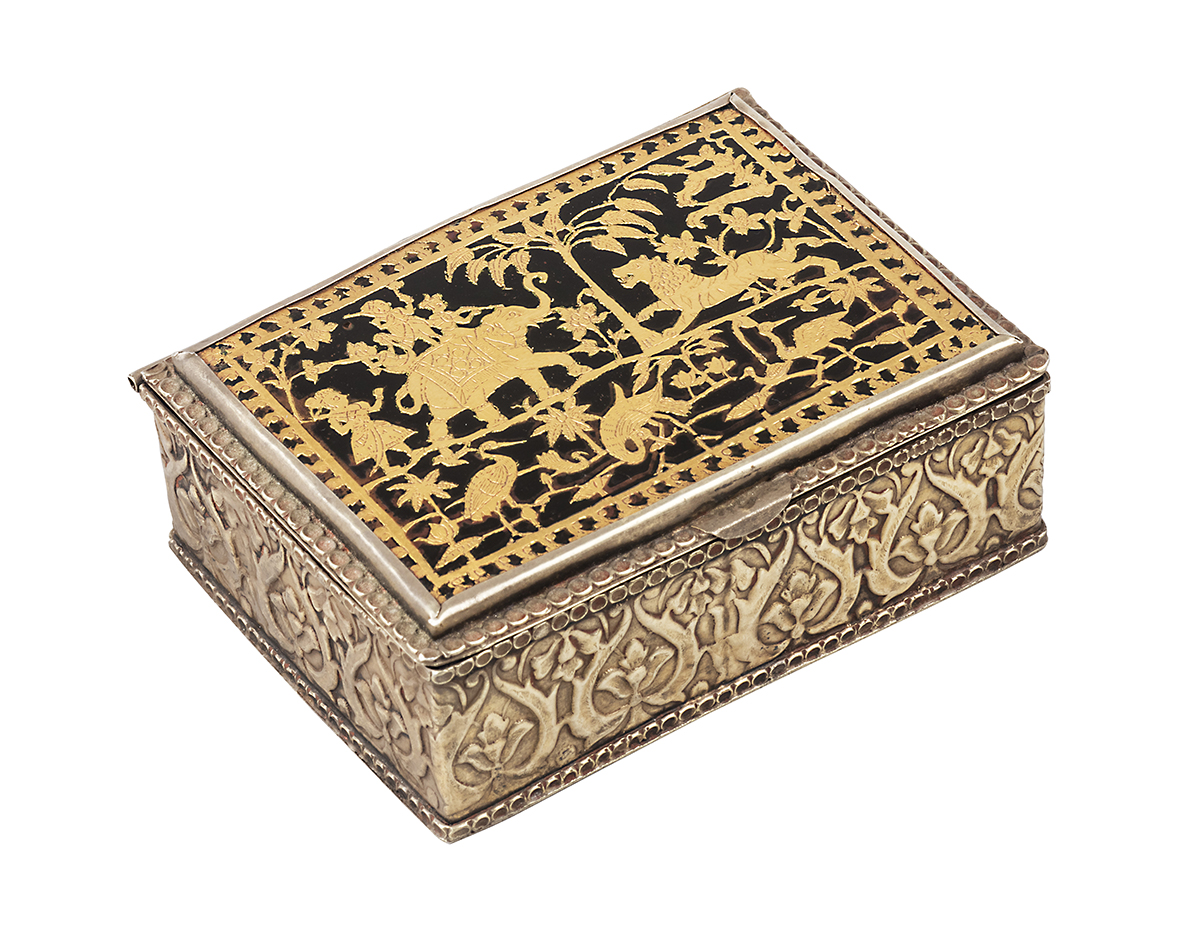
Thewa Box
India (Partabgarh, Rajasthan),
late 19th century
Height: 2.6 cm
Length: 7 cm
Depth: 5.5 cm
A rectangular silver box inset with an amber red glass panel to the top of the hinged cover, decorated in the thewa technique, whereby a sheet of delicately pierced and patterned gold foil is fused by the application of heat to the transparent coloured glass below, then mounted within a silver-gilt frame. The scene depicted is a hunting scene with hunters on an elephant shooting at a rearing tiger, with storks and cranes amidst the water lilies in the stream or lake below.
The silver box on which the thewa panel is set is decorated in repoussé with scrolling floral designs of trefoil flowers within leaf palmettes spaced by pendant trefoil flowers dangling from a vine. The whole is therefore a harmonious blend of gold, silver and silver-gilt against which the amber glass richly gleams.
Partabgarh in Rajasthan was formerly a small Rajputana principality with its own ruler, established by Maharawat Partab Singh at the beginning of the eighteenth century. Its poetic name is a combination of partab meaning bow-shot or the range of the arrow’s flight, and garh (city). Thewa simply means “setting” in Rajasthani Hindi. According to Henrietta Sharp Cockrell, the earliest known dated piece of thewa is a portable Hindu shrine given to John Malcom, an administrator in central India, in 1822. The quality of the thewa panels on the shrine support the view that the technique was already well established by this time and possibly since the eighteenth century.(1)
Craftsmen in Partabgarh claim that this unique technique, practised only by men of a related family called the Raj Sonis, originated seven generations ago with Nathuni Sonewalla, a goldsmith ancestor of the family who created the style in 1767. The source of his inspiration is unknown as it resembles no other in India and the process remains to this day a closely guarded secret. Oppi Untracht provides a detailed analysis combining partial information reticently provided by living craftsmen, and logical deductions based on his examination of jewelled pieces through a magnifying loop.(2)
The process begins with a thin sheet of 24-karat gold laid down on a board covered with lac. The lac is warmed and the metal pressed tightly onto it. When the lac cools and hardens its resilience supports the pressure of tooling. The subject is drawn in outline with a steel scriber (sui). Varied details within the outlines are created with small chasing punches (chheni), each face having different shapes and patterns such as dots, circles, straight and curved lines, and textures. The punch is tapped lightly with a small metal rod, slight pressure being enough to make an impression on the thin foil. The background of the design is then removed by piercing with tiny chisels called tankla so that the glass can be viewed through the openings.
The glass is said to come from Kashmir or imported from Europe, perhaps Bohemia or Poland. Sheets are cut into a shape corresponding to the patterned gold foil. The glass is placed on mica, which will not adhere to the glass when heated, then the foil is placed on top of the glass and the whole placed in an open clay crucible filled with sand and ash. Blowpipes bring up the temperature to turn the glass red hot. At this point the gold fuses with the glass and the amalgamated whole is immediately withdrawn from heat and allowed to cool slowly to allow for the unequal rate of contraction between glass and metal. Cooled too quickly and the glass might crack. The temperature of the crucible is well below the melting point of gold and because the gold is 24-karat and pure, no discolouring oxides form during heating as might happen with gold alloys containing copper.
The glass is then mounted in a silver-gilt frame that has been prepared to the correct size. Before this is done a flat sheet of brightly polished silver or tinfoil (varak) is placed in the closed back setting below the thewa unit to reflect light through the glass.
A thewa box from the collection of the Right Honourable The Baroness Thatcher of Kesteven, LG, OM FRS was published in the Simon Ray 2016 Indian & Islamic Works of Art catalogue, pp. 91-91, cat. 38.
Provenance:
The Sam Kenrick Collection
It was during his time in India and Sri Lanka as a development officer for Christian Aid and later Oxfam that Sam Kenrick really became interested in the art of the sub-continent. His Asian collection consists of paintings depicting Indian subjects by both Indian and European artists, and art from India and Sri Lanka, from the fifteenth to the twentieth centuries.
References:
1. Henrietta Sharp Cockrell, in “Thewa work of Pratapgarh (Partabgarh)”, a discussion of thewa objects in the Khalili Collection in Pedro Moura Carvalho, Gems and Jewels of Mughal India: The Nasser D. Khaili Collection of Islamic Art, Vol. XVIII, pp. 272-283, cat. nos.156-163. Thewa work in the Victoria and Albert Museum is illustrated in Susan Stronge, Nima Smith and J. C. Harle, A Golden Treasury: Jewellery from the Indian Subcontinent, 1988, pp. 105-107, nos. 119, 120 and 121, and pp. 108-109, no. 124 for Sir John Malcom’s shrine.
2. Oppi Untracht, Traditional Jewelry of India, 1997, pp. 300-303.