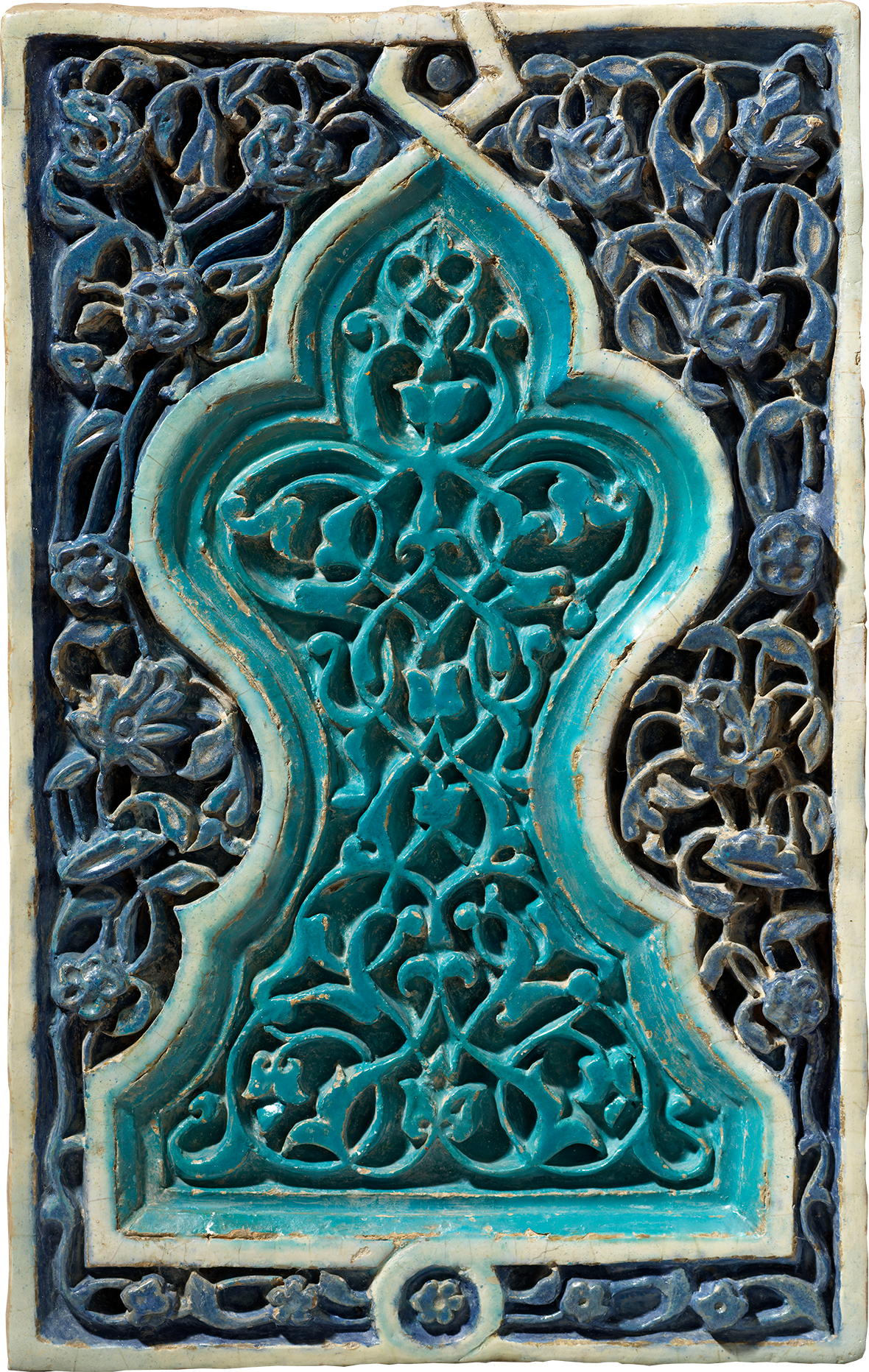
Trefoil Palmette
Western Central Asia (Timurid),
late 14th century
Height: 52.8 cm
Width: 33 cm
Depth: 7 cm
A magnificent carved and glazed terracotta panel of rectangular form enclosing a trefoil palmette standing on a short waisted foot, the surface densely filled with elegant scrolling floral and leafy arabesques in luminous glazes of rich turquoise, white, lilac and purplish cobalt blue. The terracotta is delicately carved in high relief to give the pierced effect of a veil of lace, the subtle glazes floating against the deeply recessed ground.
Though carved and glazed terracotta is a characteristic Timurid technique of the fourteenth century, this panel is unusual for its many levels of relief. The central trefoil palmette is recessed from the surface of the tile and framed by a stepped border comprising a bold white outline that loops elegantly to the top and bottom in contrasting angular and round knot forms, and a turquoise cavetto leading to a lower turquoise inner frame that surrounds the central arabesque of leaves, split-leaves and trefoil flowers and delicate buds on scrolling and interlacing vines. The angular topknot contains a single circular flower bud, while the loop to the bottom frames a six-petalled flower-head.
The cobalt arabesques to the spandrels on each side of the central palmette are drawn in a contrasting, more naturalistic style, with the flowers and leaves growing organically upwards, and lush, densely packed stems that bend under the weight of the flowers and leaves. The flowers protrude in yet higher relief above the surface of the whole panel, continuing the play in the levels of relief that is a distinctive feature of this tile panel. The flowers include variegated lotuses and composite lotus palmettes, accompanied by equally variegated leaf forms. A white border frames the whole design.
Carved and glazed terracotta is a highly attractive technique that predates the Timurid conquest, one of the earliest examples being a fragment in the Victoria and Albert Museum in London dated AH 722/1322 AD. Unlike other techniques in the wide range employed by the Timurid tile-makers, such as cut-tile mosaic and cuerda seca, carved and glazed terracotta seems only to have been used in the fourteenth century.
Literature:
Frédérique Beaupertius-Bressand, L’or Bleu de Samarkand: The Blue Gold of Samarkand, 1997. Gérard Degeorge and Yves Porter, The Art of the Islamic Tile, 2002.
Thomas W. Lentz and Glenn D. Lowry, Timur and the Princely Vision: Persian Art and Culture in the Fifteenth Century, 1989.
Roland and Sabrina Michaud and Michael Barry, Colour and Symbolism in Islamic Architecture: Eight Centuries of the Tile-Maker’s Art, 1996.
Venetia Porter, Islamic Tiles, 1997.