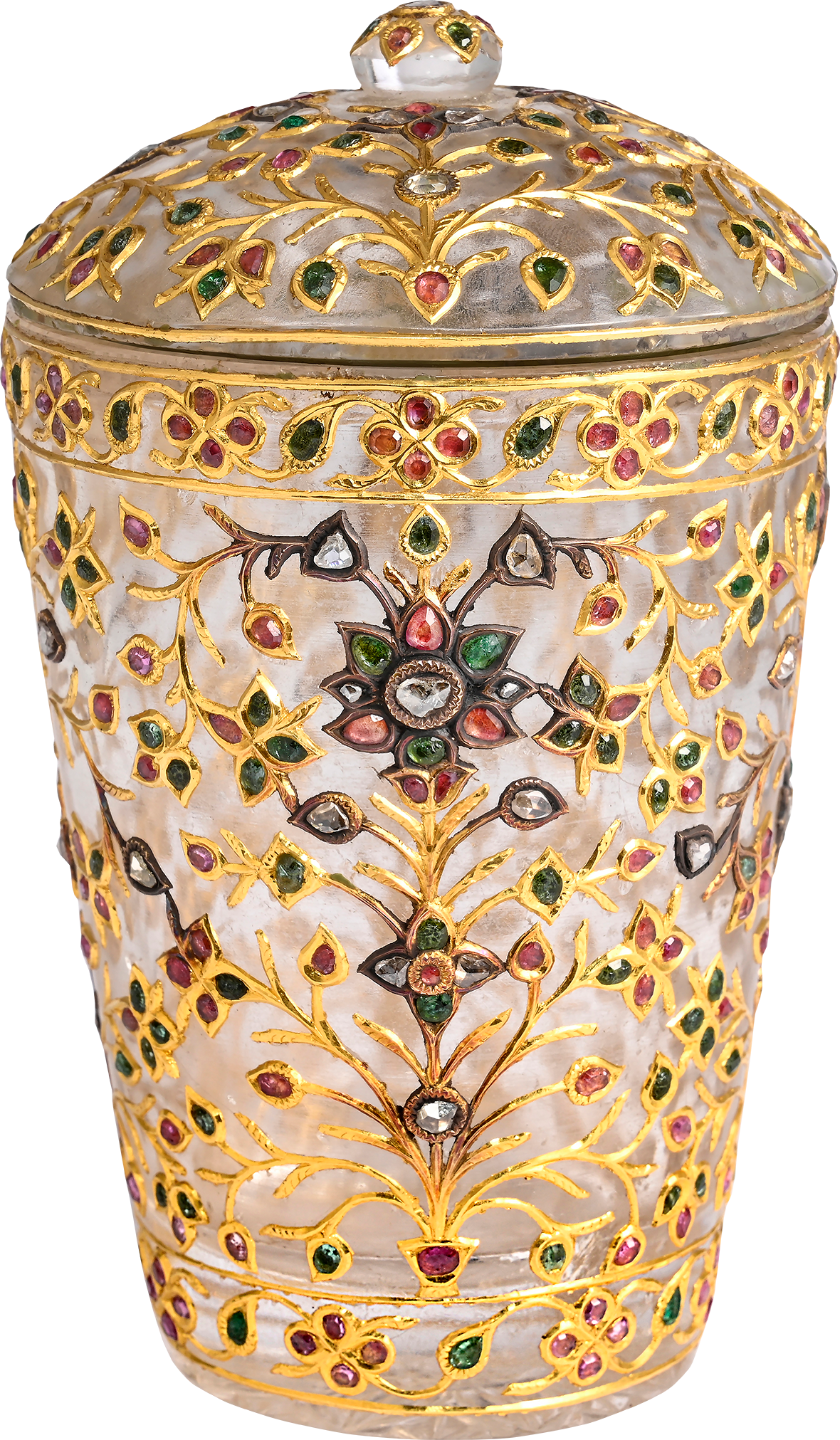
Gem-Set Rock Crystal Cup and Cover
Northern India, early 19th century
Height: 12 cm
Diameter: 7.2 cm
A carved, polished and gem-set rock crystal cup and cover, the cup of tall, elegant tumbler form with a circumference that widens gradually from the foot to the rim, the cover of gentle dome shape surmounted by bud-shaped knop finial. The cupand cover are inlaid with gold scrolling tendrils in the kundan technique and set with diamonds, rubies and emeralds within chased gold collets to form flowers, leaves and buds on arabesque vines of gold. The gold has worn on some of the flowers and vines to reveal the underlying silver. The technique used is thus shown to be silver-gilt, where the floral patterns applied in silver are gilded by embellishments of gold.
The body of the cup is decorated with a frieze of tall vertical floral sprays that fit the gradually widening shape of the rock crystal surface. At the base of each floral spray is a tiny wine cup set with e cabochon ruby from which the plant rises, thrusting upward and sprouting bifurcating branches that bear an ever greater abundance of leaves and flowers with increasing numbers of petals. A flower with diamond centre set in an engraved collet that forms its simple ruffled petals, like a sunflower, is surmounted by a quatrefoil flower-head with a ruby centre and alternating diamond and emerald petals. Crowning the design is the largest and most elaborate flower with a ruby calyx, eight mmultic-colouted gem-set petals, a central diamond set in a an engraved and chased collet, and a nodding finial of a single petal worn like a sarpech. The frieze of tall floral sprays is framed to the top at the rim and the bottom at the foot of the cup by band so scrolling vines bearing quatrefoil flower-heads with circular petals set with rubies. The ruby flowers alternate with single emerald green leaves set on a diagonal to impart an anti-clockwise flow to the pattern.
The base of the cup is carved in the form of a stylised flower with a hatched centre and overlapping petals. The Ford inventory no. 1-12 is painted on the base in black.
The cover or lid of the cup is s decorated with closely related gem-set floral arabesques arranged in quadripartite formation. Four floral sprays, each rising from a tiny mound and widening to occupy a quarter of the surface of the cover, flank the central knop finial. As the flowers seem to open and blossom in ever increasing profusion, spiky unadorned gold tendrils give way in turn to single buds and leaves, that yield in turn to trefoil then quatrefoil flowers to impart a luxuriant effect of dense growth. The finial is ornamented with a six-petalled flower-head, each gem-set petal floating detached from the central circular gold collet where gadrooning frames the diamond.
A gem-set rock crystal covered bowl and dish with similar decoration is in the collection of the Asian Civilisations Museum, Singapore.
A gem-set rock crystal covered bowl of closely related form and decoration to the Singapore covered bowl but without a dish, is in the David Collection, Copenhagen. This is illustrated in Kjeld von Folsach, Art from the World of Islam in The David Collection, 2001, p. 238, no. 360. This is dated to the eighteenth century.
Rock crystal is a colourless and transparent form of quartz. It is very much harder and clearer than glass, making it a popular medium for the carving of luxury objects, boxes, vessels and jewellery. Amongst the most celebrated rock crystal objects from the Islamic medieval courts are the exquisite products of the Fatimid workshops. These have survived in relatively large numbers, mainly in European church treasuries. While rock crystal objects continued to be produced after the fall of the Fatimids in 1171, these works of art from other periods and regions have not generated the same level of interest amongst scholars and collectors.(1)
In Mughal India there was a great revival in the art of rock crystal carving. According to Pedro Moura Carvalho, Mughal interest in rock crystal is evident not only from the number of surviving pieces but also in the numerous references to the hardstone in contemporary sources such as Abu’l Fazl.(2) Jahangir owned an unusual collection of rock crystal objects from different origins including Europe, where during the late Renaissance hardstone carving reached new heights.(3) His treasures included boxes from Europe, a crystal cup supposedly from Iraq which he gave to Shah ‘Abbas I, and a crystal figure, possibly Chinese, that he received from the king of Bijapur.(4) These varied objects stimulated the Mughal craftsmen to new heights of technical virtuosity during the reign of Shah Jahan. The kundan technique for the inlay of gold and gemstones ensured that the applied decoration of objects achieved a similarly high level of craftsmanship and design to match the superb quality of the carving.
Provenance:
Mrs Henry Ford II
References:
1. Pedro Moura Carvalho, Gems and Jewels of Mughal India: Jewelled and enamelled objects from the 16th to 20th centuries, 2010, pp. 54-56.
2. Ibid.
3. Ibid.
4. Ibid.