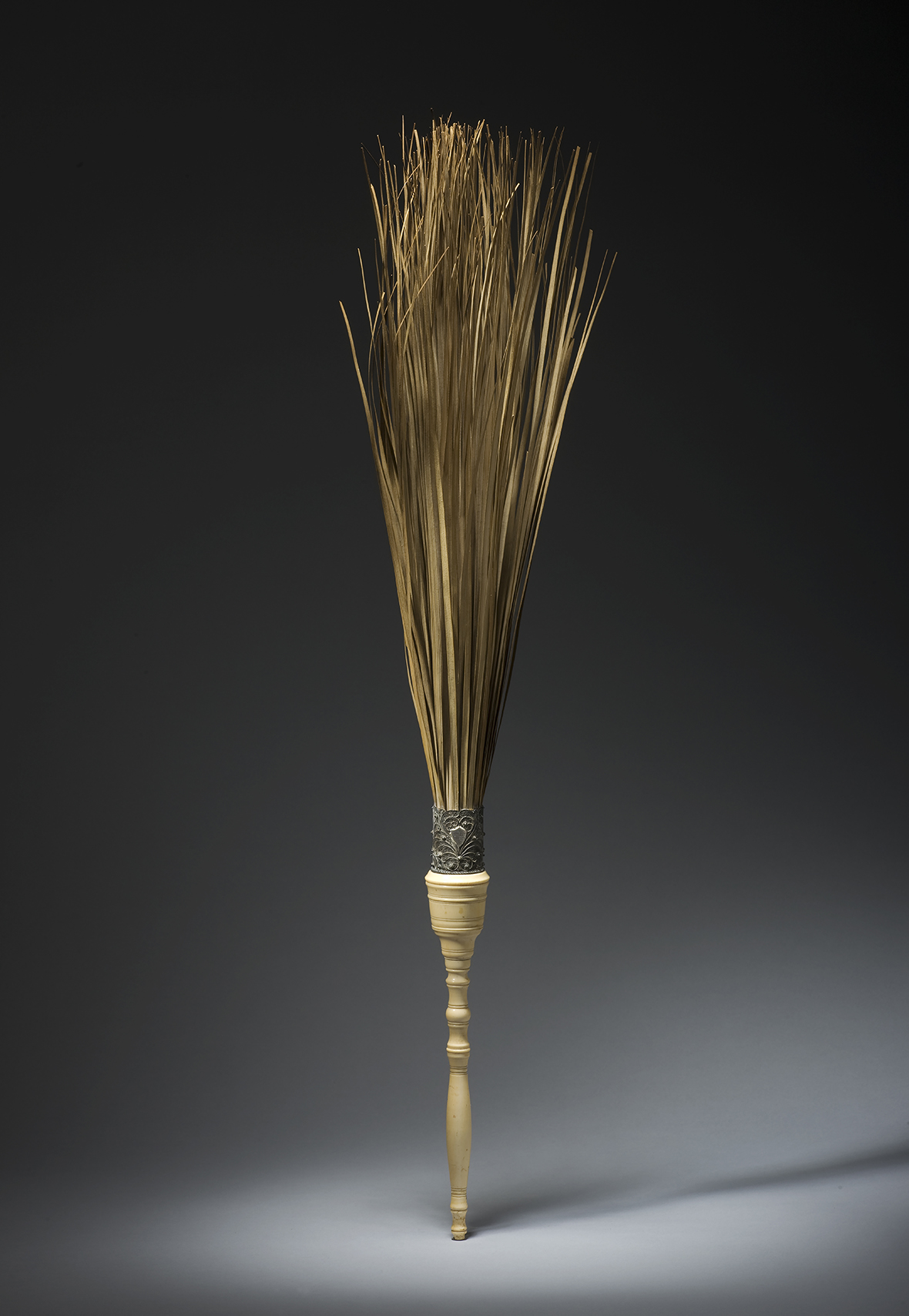
Ivory Flywhisk
India, late 19th century
Height: 76 cm
Diameter: 4.5 cm
A finely carved ivory flywhisk or chowri with individual strands of reeds used to create the hair of the whisk, all held in place by a chased silver mount.
The rich yellow ivory colour has darkened over time from its original whiter shade, something which was usual with Indian ivory. Here, the length has been carved into various rounded sections, separated by collars and thin chased edges. To the top, the handle starts to taper outwards terminating in the silver mount above, with further carved sections decorating the ground. The longest section is the grip, which tapers inwards at both ends but remains smooth and uncarved. The flywhisk terminates in a small rounded knop. The silver mount is finely chased with stylised floral sprays surrounding a central plaque. The plaque is engraved with the following:
L
1st B N
22n RT
In the miniatures of the Mughal period, the servants of noble personages carry flywhisks, but very few of them have been preserved today. The servant could use this type of whisk not only to shoo away flies, but also to create a gentle, cooling breeze for his master. The flywhisk had ancient associations of power and divinity in India, and had become one of the standard insignia of royal authority in Hindu and Muslim courts alike.
Provenance:
The small pewter plaque suggests that the flywhisk was either made for, or at some point was in the ownership of an officer of the 22nd regiment of the 1st Battalion (The Cheshire Regiment). In 1891 the 22nd went Belgaum in India and in 1894 they marched the 200 miles across India (it took them 3 weeks) to Madras. In 1895 they found themselves in Secunderabad where the Adjutant was one William Martin-Leake. After 4 years in Secunderabad, they moved to Quetta and then in October 1903 the moved to Bombay and left India finally in 1904. Leake seems to be the only officer with the initial "L" during the latter part of the nineteenth century and so it is possible that the flywhisk was given to him as a present at some point.