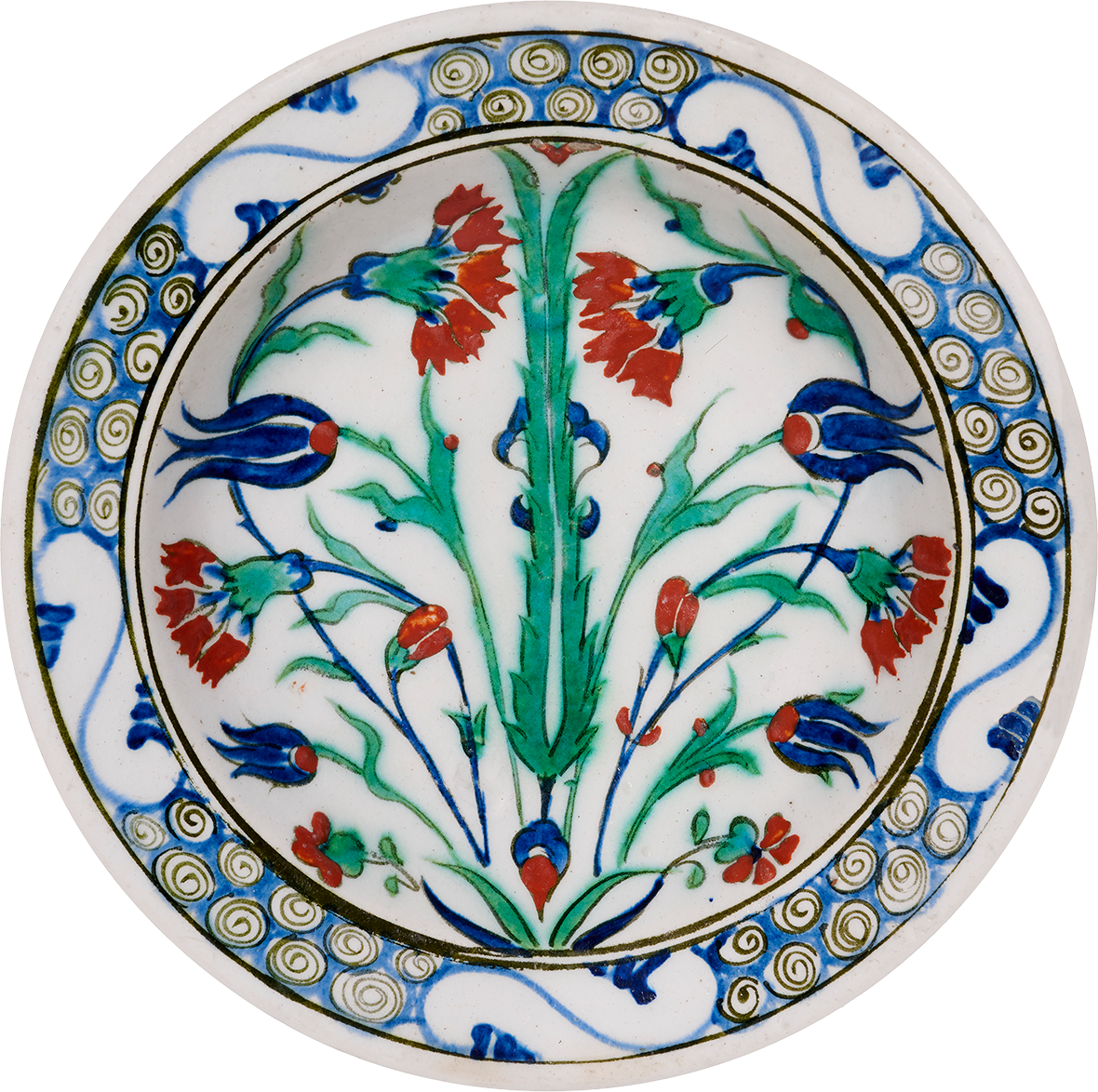
Cyrpress Tree Flanked by Carnations and Tulips
Turkey (Iznik), late 16th century
Height: 4.8 cm
Diameter: 25.6 cm
A polychrome underglaze-painted dish standing on a short recessed foot, the crisp white interior finely painted in cobalt blue, emerald green, black and rich sealing wax red or Armenian bole in low relief with a design of floral sprays within a scrolling border.
This unusual design depicts a centrally placed single emerald green cypress tree emerging from a small blue and red cartouche below. It has serrated edges and bifurcated tips that pierce the background and is further decorated by a cusped cobalt scrolling motif to the middle. Surrounding the tree are stylised sprays of carnations and tulips in blue and raised red hues; the flowers heavy enough to bend the blue and green stems under their own weight. A pair of smaller floral sprays with sealing wax red petals fill the remaining ground around the base of the cypress. The main field is contained within double lined borders and to the rim is a breaking wave and rock design in cobalt blue, the curls of the rock formations painted in black. The reverse of the dish depicts alternating floral motifs in emerald green and cobalt blue. An old collection label is also visible.
An almost identical dish is published in John Carswell, Mina Moraitou and Melanie Gibson, Iznik Ceramics at the Benaki Museum, 2023, p. 98. For similar designs on other Iznik dishes, see the Metropolitan Museum of Art, Object Number: 66.4.8 and Frédéric Hitzel and Mireille Jacotin, Iznik - L’Aventure d’une Collection: Les céramiques ottomanes du musée national de la Renaissance Château d’Ecouen, 2005, pp. 115 - 117.
The cypress tree first appeared in Ottoman ceramic designs in the fifteenth century and was probably influenced by Yuan dynasty Chinese porcelain where cypresses are depicted as if covered in scales. The cypress was first seen on Iznik dishes in the second half of the sixteenth century and was also often used in Ottoman poetry as a symbol of beauty and grace. The influence of Chinese porcelains on the wares of Iznik is also seen here in the wave border, an early fourteenth century Yuan prototype that was to be a lasting influence on both later Chinese porcelain and Iznik ceramics. To the Ottoman potter, any mythological associations this motif may have had for the Chinese were unknown but once attracted by its graphic power, continued to be used well into the seventeenth century. By the 1570s the wave border, increasingly removed from its Chinese model, had become a standard of Iznik dishes. In its final metamorphosis it became so stylised as to be unrecognisable, to the point of being described as “ammonite scrolls”. The very first Iznik examples however, imitate the Yuan waves closely, their rollers painted with feathery parallel lines. On this plate the scrolls are painted with fresh spontaneity, adding to the overall sense of vibrant movement.
Provenance:
Private US collection
References:
1. Nurhan Atasoy and Julian Raby, IZNIK: The Pottery of Ottoman Turkey, 1989, p. 121.
2. Ibid.