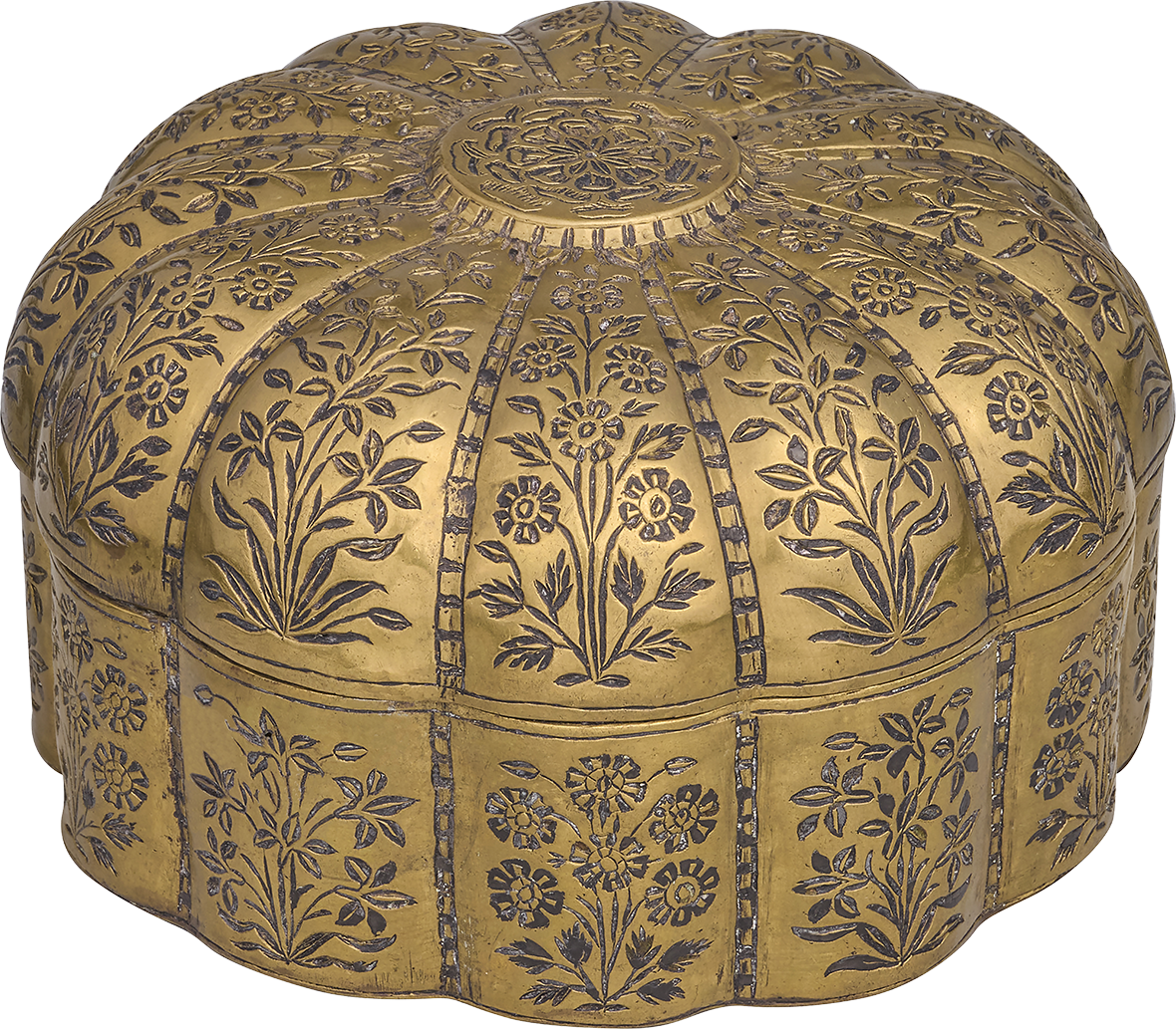
Ribbed Floral Pandan
Northern India, late 17th century
Height: 7.6 cm
Diameter: 13.3 cm
A cast and engraved brass circular ribbed pandan (betel container), decorated with fields of alternating stylised floral sprays to the base and lid below a raised central rosette medallion to the top.
The body of the pandan has twelve rectangular ribbed sections featuring alternating freely drawn six-petalled sprays of lilies and rosettes, each framed to either side by hatched borders and above and below by single lined borders. The domed lid of the box is arranged to accommodate twelve tapering panels, each one alternating the floral designs of those on the body below. Again, the sections are further marked by hatched vertical borders but here, stylised lappets frame the designs to the top, where they surround a central raised medallion with a single radiating floral spray. Originally this pandan would have been decorated with red and green lac inlay, and whilst a few traces remain, most of this has been worn away over the years.
Pan is created by taking thin slices of the nut of the areca palm (supari or Areca catechu) then mixing with lime paste (chunam) made from ground seashells and spices. The whole is then wrapped in a fresh leaf of the betel tree (Piper betle).(1) Early betel containers such as the present seventeenth century example have no interior compartments or divisions and must have been used to hold the pan quid after it had been stuffed and rolled ready to eat, rather than the individual ingredients for it in separate sections, as seen in most of the larger pandans of the nineteenth century.(2)
Provenance:
Pierre Jourdan Barry Collection
Published:
Mark Zebrowski, Gold, Silver & Bronze from Mughal India, 1997, p. 273, cat. no. 468 and pl. 491.
References:
1. Mark Zebrowski, Gold, Silver & Bronze from Mughal India, 1997, p. 263.
2. Ibid., p. 264.